
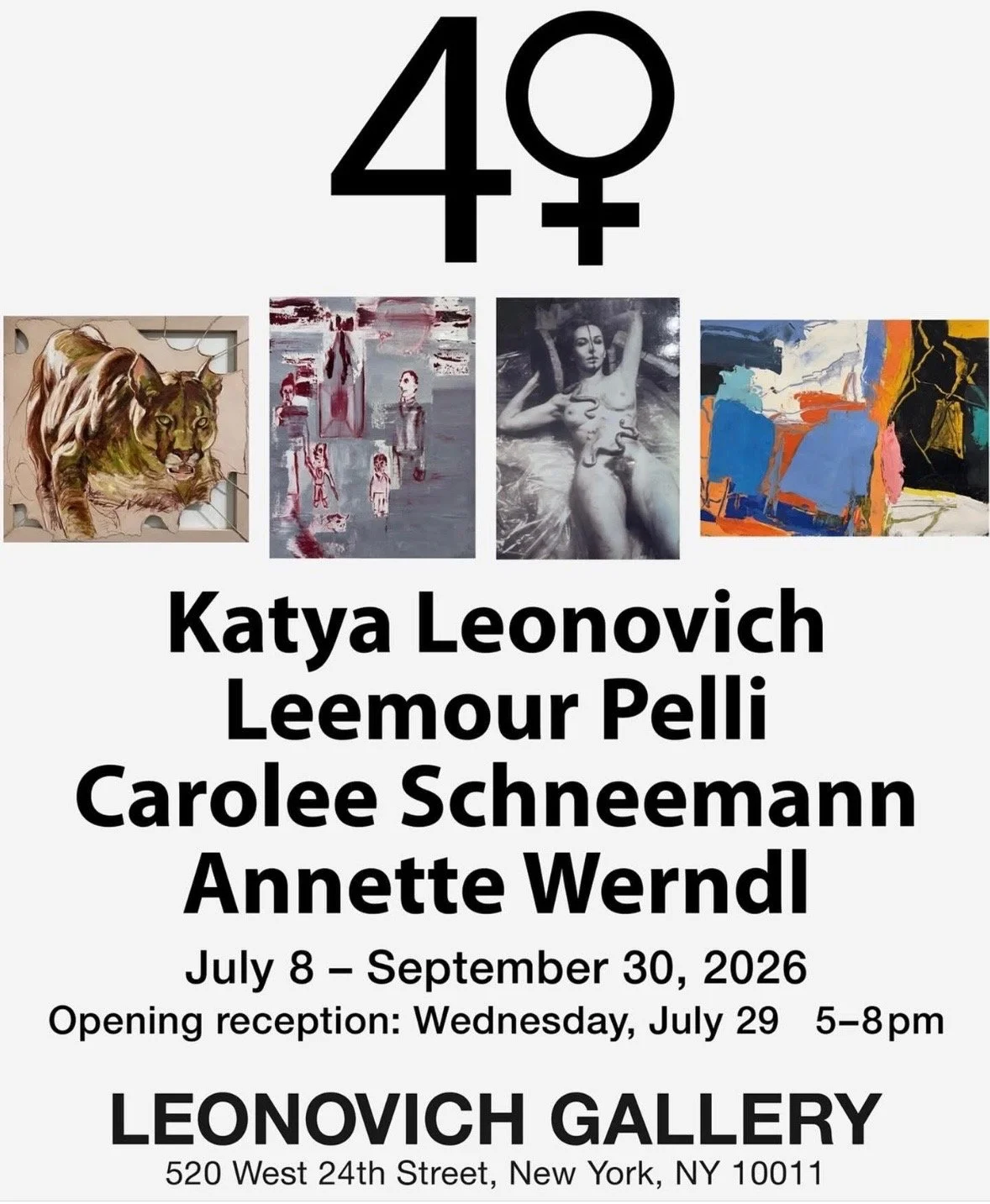
This summer show, 4♀, at Leonovich Gallery, curated by Katya Leonovich and Elga Wimmer, which opens July 8, and runs through the fall, September 30, 2026, presents works by four pioneering women artists: Leemour Pelli, Carolee Schneemann, Annette Werndl, and Katya Leonovich.
When the Guggenheim Museum Soho opened in June 1992 (closed 2001)—an event that purported to showcase the best of the art world at that time—the roster of artists was dominated by men. Only two women artists were included in the show, Louise Bourgeois and Louise Nevelson.
Consequentially, many women artists including organizations such as the Guerilla Girls and the Women’s Action Coalition (WAC), as well as the influential art collector Werner Kramarsky protested in front of the museum this dearth of female artists. Fast-forward to today, and we see that bankable artists—those shown in major galleries and museums—still skew heavily towards men.
4♀ showcases the works of four contemporary women artists spanning three generations, who have different approaches to making art, utilizing varied media.
Annette Werndl, who lives and works in Germany, produces abstract paintings in bold colors evoking nature, city streets, landscapes in superimposed luminous strokes. Her orange, purple, green, blue, yellow, brown—an explosion of colors—recalls Sam Francis, or the color fields of Helen Frankenthaler. The common factor connecting these artists being the exploration of color, light and empty space.
Werndl’s luminous, lyrical painting style feels lighter, more fluid than that of the Abstract Expressionists, taking on a more contemporary mix of color field and abstraction. At times the artist depicts a monochromatic background, making colors and shapes stand out as if illuminated from within (see “Guyarani” and “Bhutia”, oil on canvas, 2026). Like many artists who use music as inspiration, such as Piet Mondrian with jazz, Keith Haring with hip hop, Werndl’s creative process is often accompanied by music too, in particular jazz, blues and pop, which resonates in her rhythmic, dynamic strokes.
New York based Leemour Pelli tells a story in this new series of paintings, Crowa and God in Upheaval. Two fictional characters, Crow and Crowa, express human emotions moving in metaphysical realms, drawing on the artist’s own experiences and emotions.
In the tradition of American Neo-Expressionist Donald Baechler’s naïve and cartoonish style, and Dubuffet’s Brut movement with a raw child-like, graffiti esthetic, Pelli’s characters are reflections of inner thoughts, a psychological state of mind, ever changing, but staying eternally synonymous. In “Crowa Became Like a Bird” (oil on canvas, 2026), the two characters appear to land at the bottom of a piscine, it’s a tough landing, but the viewer takes solace nevertheless that they still have each other…
Carolee Schneemann (1939–2019, New York) was a pioneer in multi-media works involving the body, sexuality and gender. She regarded her physical body as an art medium, covering herself with paint, or strips of painted paper and canvas in her performance art. Her film and live performances were interspersed with painting and drawing, revealing, and embracing the action. Schneemann wrote a book titled Cezanne, She Was a Great Painter (1972), as a critique of the then dominant Abstract Expressionist male artists.
This show includes several of her iconic works, such as “Unexpectedly Research”, a storyboard assembled with images from the artist’s films and performances interspersed with mythological and anthropological photos from antiquity. In “Infinity Kisses”, a grid of nine painted-over photographs of her beloved cat’s kiss, is part of the artist’s work from her private life juxtaposed with what was happening in the world at large. A version of this work is in the collection of SFMoMA.
New York-based, Russian-born artist, Katya Leonovich, presents a new series of paintings, The Essence is Transient, the Form is Eternal, that depicts various parts of the male body in oil paint and sanguine on leather. We see floating feet in various positions, a view of the body from different angles, a portrait gazing at the viewer, culminating with a charging lion.
What once seemed taboo for female artists, depicting the male body, is for Leonovich a frequent subject matter. In the series’ namesake painting, “The Essence is Transient, the Form is Eternal”, three pairs of feet forming a triptych are depicted as if studies, from every angle, wrapped above the ankle with a white cloth. The images are reminiscent of Mantegna’s Lamentation of Christ, seen as a protagonist of theoretical perspective.
The large, ground-floor gallery space is particularly well suited to give these four women artists a platform where their work can be appreciated on its own merits in today’s art world.
- Elga Wimmer